
The Evolutionary Architecture of Virtue and Vice: An Autopsy of the Human Primate

Junho Jung
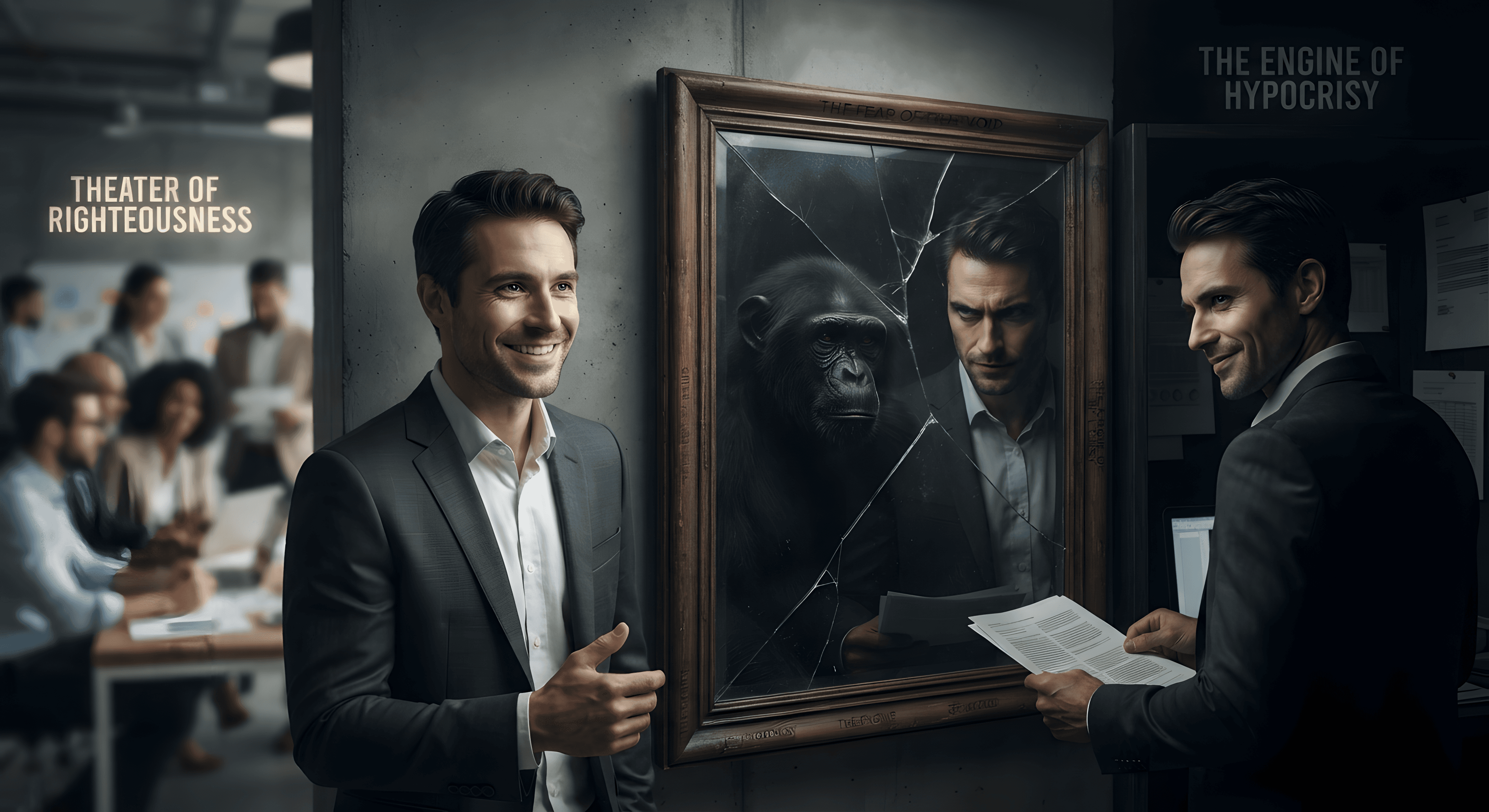
At first glance, humanity appears suspended in a permanent state of moral contradiction. We witness individuals sacrificing their time for the collective, displaying radical empathy, and adhering strictly to unwritten codes of kindness. Yet, those same individuals often pivot seamlessly into secretive cruelty, petty exploitation, and calculated hypocrisy the moment they believe they are unobserved.
To moralists and philosophers, this duality is an endless source of existential anguish. But when stripped of romantic illusions and examined purely through the lens of rigorous evolutionary psychology, the mystery dissolves. Neither saintliness nor villainy is a matter of transcendent choice; both are simply automated outputs of an ancient primate survival engine.
Part I: The Neurobiology of "Selflessness"—The Fear of the Isolation
Why do humans habitually care for others, prioritize the collective, and project an aura of profound goodness? The answer does not lie in a pure soul, but in the brutal mechanics of neurobiology.
Human beings are obligate social primates. For millions of years of ancestral history, exile from the tribe meant absolute, unmitigated death. To prevent this fatal isolation, natural selection hardwired a dedicated alarm system directly into the human brain—specifically targeting neural networks like the dorsal anterior cingulate cortex, which processes physical pain. When a human is ignored, rejected, or threatens the social cohesion of the herd, the brain fires off distress signals functionally identical to physical trauma.
Therefore, what we label as "altruism" or "goodness" in everyday life is, at its root, a biological defense mechanism against the terror of exclusion. Humans are cooperative not because they are inherently angelic, but because their brains coerce them into compliance through the threat of neurological agony. Conforming to collective norms, practicing superficial kindness, and appearing outwardly virtuous are simply the entry fees required to keep the tribe from casting an individual out into the wilderness.
Part II: The Persistence of the Beast—The Engine of Hypocrisy
If survival demands cooperation, why do humans simultaneously harbor ruthless selfishness, greed, and a relentless drive for dominance?
Because the ancient, predatory hardware of the primate brain is never actually overwritten. While the modern linguistic and social software forces individuals to project harmony in the light of day, the core biological imperative remains singular: maximize personal and genetic reproductive success at the lowest possible personal cost.
When the protective gaze of the herd is removed—when anonymity is guaranteed or structural loopholes present themselves—the evolutionary pressure to conform evaporates. The hidden exploitation, the behind-the-scenes backstabbing, and the covert cruelty are not anomalies or moral failures; they are the unadulterated execution of primal instincts. The individual who smiles politely in public while exploiting the vulnerable in private is simply maximizing their fitness across two different operational environments: the cooperative herd and the competitive hierarchy.
What we call "hypocrisy" is, in evolutionary terms, optimal adaptation. It is the art of maintaining the protective shield of social inclusion while simultaneously extracting private resources through exploitation.
Conclusion: The Machinery Without Morality
To evaluate these dual behaviors through a moral lens—labeling one "good" and the other "evil"—is a fundamental category error.
Evolutionary psychology recognizes no virtues and no sins; it recognizes only strategies. The apparent kindness of the human animal is a fear-driven compliance mechanism designed to prevent fatal isolation. Its hidden cruelty is the ancient, unyielding drive of a predator securing dominance within the pack.
Humans are not fallen angels striving for redemption, nor are they inherently corrupted beasts. They are sophisticated biological automata—fearful of the dark, desperate for the herd, and endlessly clever at disguising their survival calculations behind a glittering theater of righteous words.