
The Hierarchy of Wisdom: The Precision of Thought vs. The Cost of Empiricism
Junho Jung
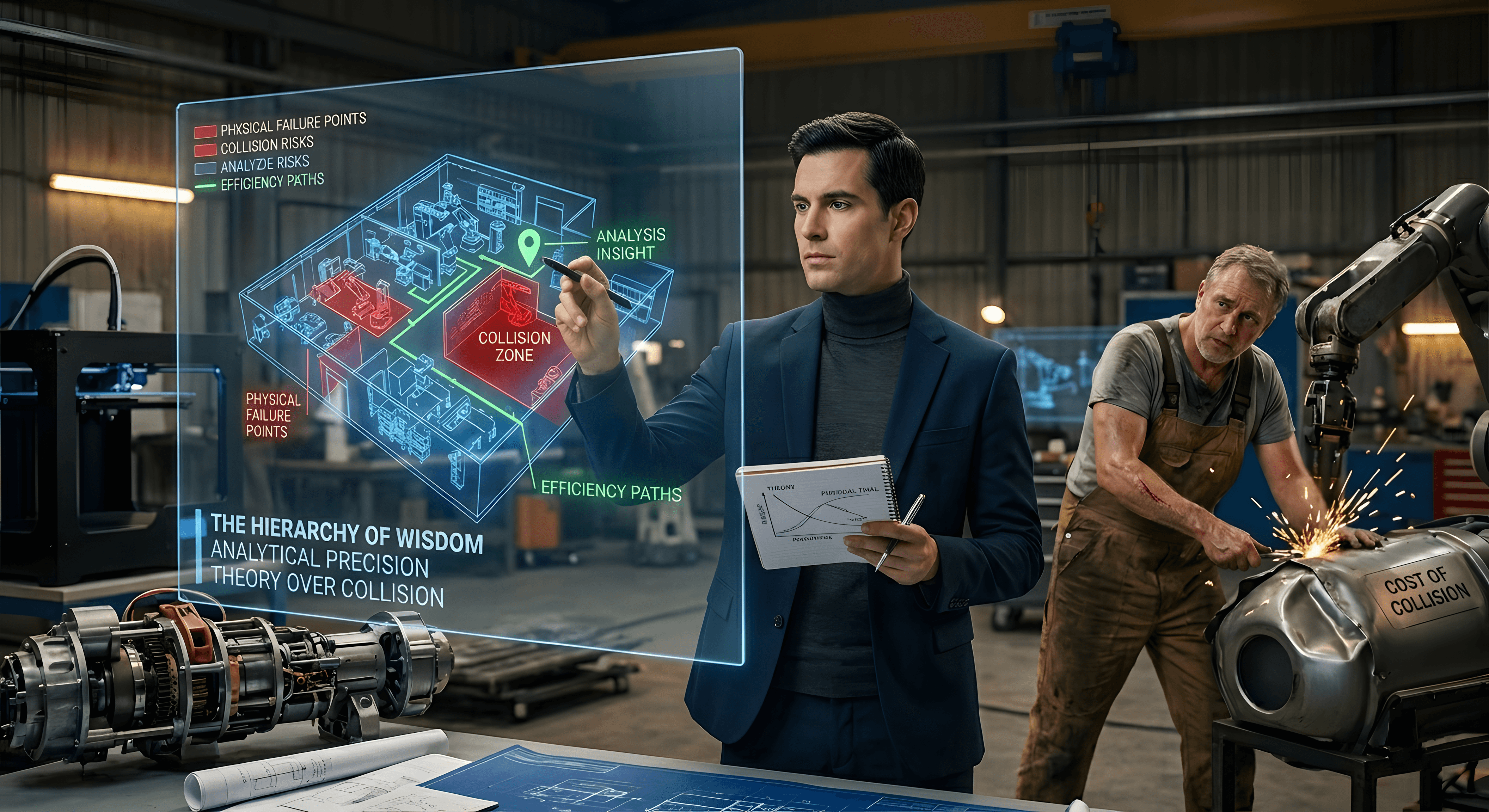
The fundamental distinction between individuals in the acquisition of wisdom lies not in the amount of their experience, but in the efficiency of their cognitive processing—specifically, their capacity for high-fidelity abstraction versus the reliance on brute-force empirical trial.
At one end of the spectrum are those who treat knowledge as a navigable map. By synthesizing information through rigorous intellectual inquiry and deep reflection, they can decode the causal mechanisms of the world through indirect experience. They possess the ability to extract universal truths from minimal datasets, realizing that one does not need to walk every inch of a terrain to understand its geography. For them, the intellectual labor of deconstruction replaces the physical labor of trial, allowing them to bypass the visceral costs of failure.
Conversely, there are those who maintain that wisdom is solely a product of "learning by bruising"—that direct, sensory-based validation is the only path to truth. This is a common defense mechanism. While it is true that one must start with some baseline of data, the insistence that physical trial and error is "essential" for everyone is a fundamental misunderstanding of intelligence. It ignores the reality that high-level cognitive capacity allows for the extrapolation of principles from limited data points. To claim that one must experience a failure to understand it is to admit a limitation in one’s own analytical precision.
The tragedy arises when these two modes collide. Those who have built their worldviews on the bedrock of raw, physical struggle often romanticize their scars as evidence of superior merit. They mistake the necessity of their path for a badge of honor, frequently looking down upon those who navigated life with intellectual efficiency. However, this is a categorical error. They mistake the cost of their education for the value of the lesson.
True intellectual maturity requires acknowledging that the most elegant form of wisdom is not that which is bought with the highest price of personal suffering, but that which is synthesized through the keenest understanding of cause and effect. The "trauma" often cited as a teacher is, in reality, a symptom of delayed learning—a sign that the individual was unable to perceive the wall until they had already struck it.
Ultimately, the goal of sophisticated thought is to minimize the distance between the observation of a mechanism and the comprehension of its outcome. Wisdom is not the resilience required to recover from a collision; it is the analytical precision that renders the collision unnecessary.