
The Illusion of Morality: An Evolutionary Autopsy of the Human Animal

Junho Jung
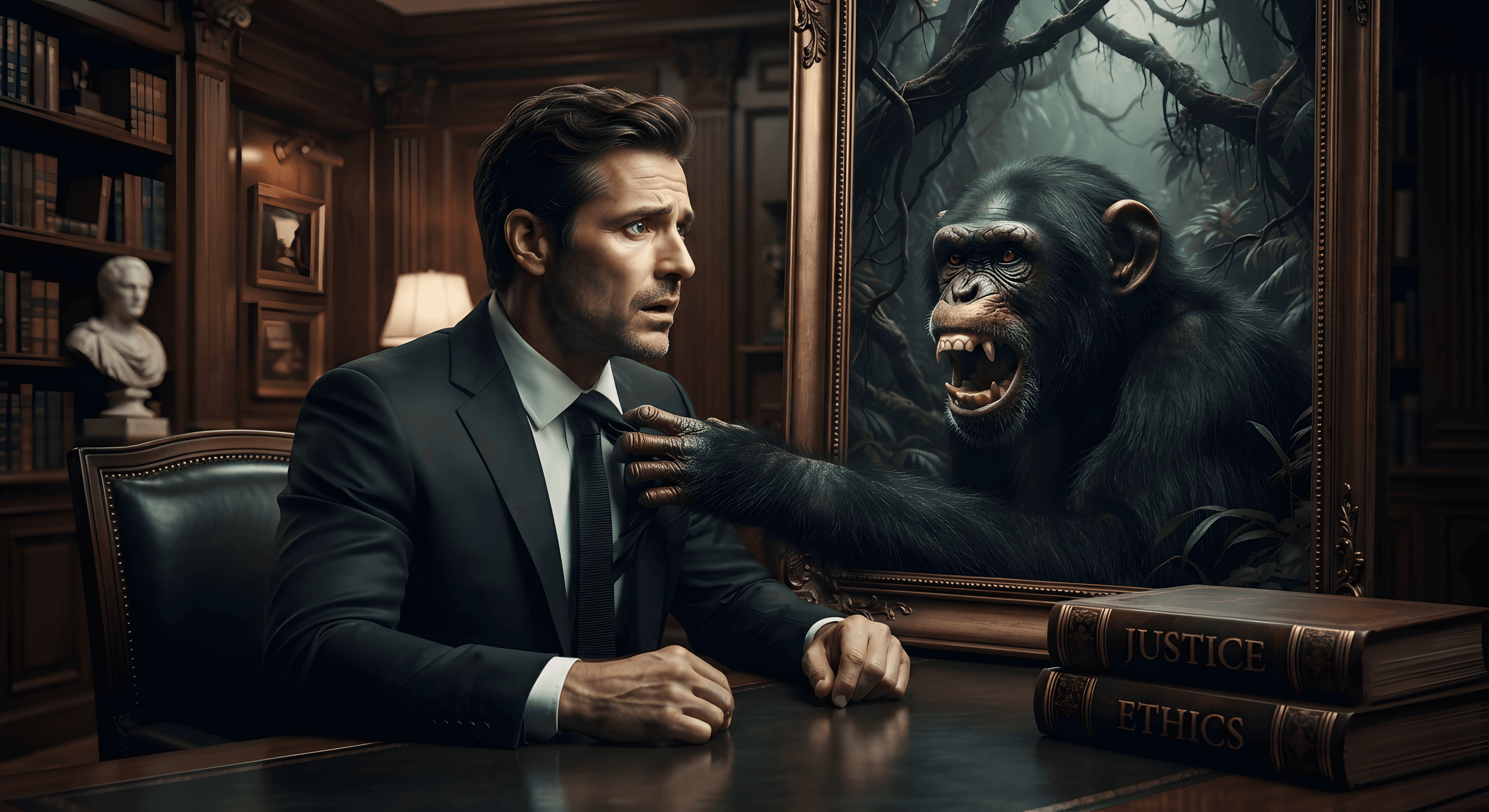
At our core, humans like to think of ourselves as creatures of high moral standing, uniquely separated from the rest of the animal kingdom by our conscience, empathy, and pursuit of justice. Yet, when stripped of romanticized illusions and examined purely through the lens of evolutionary biology, a far more sobering reality emerges. The human self-portrait is not that of a noble apex creature, but rather of a sophisticated primate running ancient, unevolved survival code—while using language to hide it.
Part I: The Fallacy of Disgust—Why Moral Outrage is an Evolutionary Error
When humanity witnesses its own predatory baseline—selfishness, cowardice, and the ruthless crushing of the weak—it recoils in visceral revulsion. We label these behaviors "despicable," "petty," or "corrupt." But from the standpoint of rigorous evolutionary science, this moral disgust is nothing more than a biological glitch: a localized friction point between our hardwired animal impulses and our abstract linguistic software.
To call human behavior "despicable" or "evil" is a fundamental error. Nature does not recognize morality; it recognizes only adaptation and extinction. The bully, the fraud, and the coward are not violating the laws of the universe; they are successfully executing the exact same survival mechanics that govern every social mammal on Earth. The subjective feeling of revulsion is merely an automated alarm system designed by the herd to punish anyone who threatens the fragile collective illusion.
Part II: The Universal Trajectory—Why All High-Functioning Species Converge on Humanity
If humanity's traits are merely the product of primate hardware mixed with linguistic software, a provocative question arises: Is this unique to Earth, or is it an inevitable evolutionary destination?
If any social, high-intelligence animal on another world were to develop abstract communication, it would inevitably undergo the exact same psychological and social metamorphosis. Intelligence requires modeling reality, predicting threats, and securing resources. When a high-IQ species lives in cooperative groups, it necessarily inherits the dual drives of tactical predation and herd dependency.
Once language emerges in such a species, it must codify its survival strategies into rules to reduce internal friction. It will invent concepts of "fairness" to keep the weaker members compliant, and it will build "morality" to mask individual selfishness under the guise of collective good. Therefore, the human condition is not a freak anomaly of the cosmos. Any sufficiently advanced, highly intelligent social animal that invents language will inevitably build the exact same theater of hypocrisy, self-deception, and moral posturing.
Part III: The Ultimate Truth of Morality—The Grand Treaty Against Mutual Destruction
This brings us to the core question: Why did humans invent morality in the first place?
The answer is ruthlessly simple: The prevention of mutual destruction through deception.
All social animals experience an inherent drive for dominance and a sense of superiority. When animals equipped with this primal urge finally invented language, it was completely natural—and biologically inevitable—that they would use it to self-aggrandize and beautify their own image.
Yet, unbridled predation and constant warfare destroy resources and guarantee mutual annihilation. Thus, humanity collectively forged a massive, unspoken pact. Morality is nothing more than a giant social treaty designed to hide our raw nature, minimize friction, and avoid unnecessary conflict by sparing others the raw, abrasive offense of our true intentions. It is an evolutionary safety valve, nothing more and nothing less.
Conclusion: The Ultimate Irony
The human condition is a grand evolutionary irony. We are beasts of the herd, equipped with the tactical cruelty of predators, the fearful dependencies of prey, and the supreme cognitive capacity to write thousands of books praising our own righteousness.
Morality is a linguistic hallucination—a comforting coat of paint over a brutal machine of survival. We are not fallen angels, nor are we flawed saints. We are biological mechanisms, and those who transcend the illusion of morality do not become monsters; they simply become the few who finally open their eyes to look at the machine as it truly is.