
The Tyranny of Unchecked Optimism: Why We Need a Strategic Shift

Junho Jung
The Tyranny of Unchecked Optimism: Why We Need a Strategic Shift
In contemporary society, "positive thinking" has been elevated to a secular dogma. We are constantly told to "stay positive," "believe in ourselves," and "manifest success." However, when we strip away the veneer of this cultural mandate and examine it through the lens of logic and survival, we discover a dangerous paradox: blind optimism is often a psychological anesthetic that facilitates failure, while strategic pessimism is the bedrock of mastery.
To survive and thrive in an uncertain world, we must move beyond the binary of "good" vs. "bad" mindsets and adopt a more sophisticated, situation-dependent strategy.
The Illusion of Blind Positivity
Why is society so obsessed with positivity? It is largely a mechanism for social cohesion and effortless comfort. By labeling optimism as an unalloyed virtue, we create a convenient shortcut—a "heuristic"—that allows us to bypass the exhausting work of complex risk assessment.
However, when "positivity" becomes a permanent state of mind rather than a tactical choice, it devolves into toxic positivity. It encourages us to ignore warning signs, dismiss systemic flaws, and operate under the "illusion of control." In this state, we are not motivated; we are simply blind. We aren't preparing for the worst; we are merely hoping it won't happen.
The Case for Strategic Pessimism (When Things Are Going Well)
The most dangerous time for an individual or an organization is when they are succeeding. Success breeds the "optimism bias," which often manifests as hubris. We attribute our wins to our own genius, overlooking the roles of timing, luck, and hidden variables.
This is the precise moment to deploy Strategic Pessimism.
The Logic of Defense: When you are at the peak, you must act as your own devil's advocate. By assuming that current success is fragile and that unforeseen variables could trigger a downturn, you tighten your guard.
The Buffer Effect: Strategic pessimism at the height of success acts as a defensive anchor, preventing the over-expansion and arrogance that inevitably lead to "the winner’s curse."
The Case for Strategic Optimism (When Things Go Wrong)
Conversely, when we face failure, the natural human reaction is often "learned helplessness"—a collapse into a deep, unproductive pessimism. We mistakenly believe that because we failed, we are inherently incapable.
This is exactly when Strategic Optimism must be deployed.
The Catalyst for Rebound: After a failure, optimism should not be used to deny the reality of the defeat, but to fuel the analysis required for a comeback. It is the belief that "my current failure is an data point, not a verdict, and I possess the capacity to adjust my strategy."
The Utility of Re-framing: By shifting to optimism here, you break the cycle of self-blame and allow yourself to objectively analyze the failure, reorganize your resources, and launch a new, more refined attempt.
Conclusion: The Wisdom of Duality
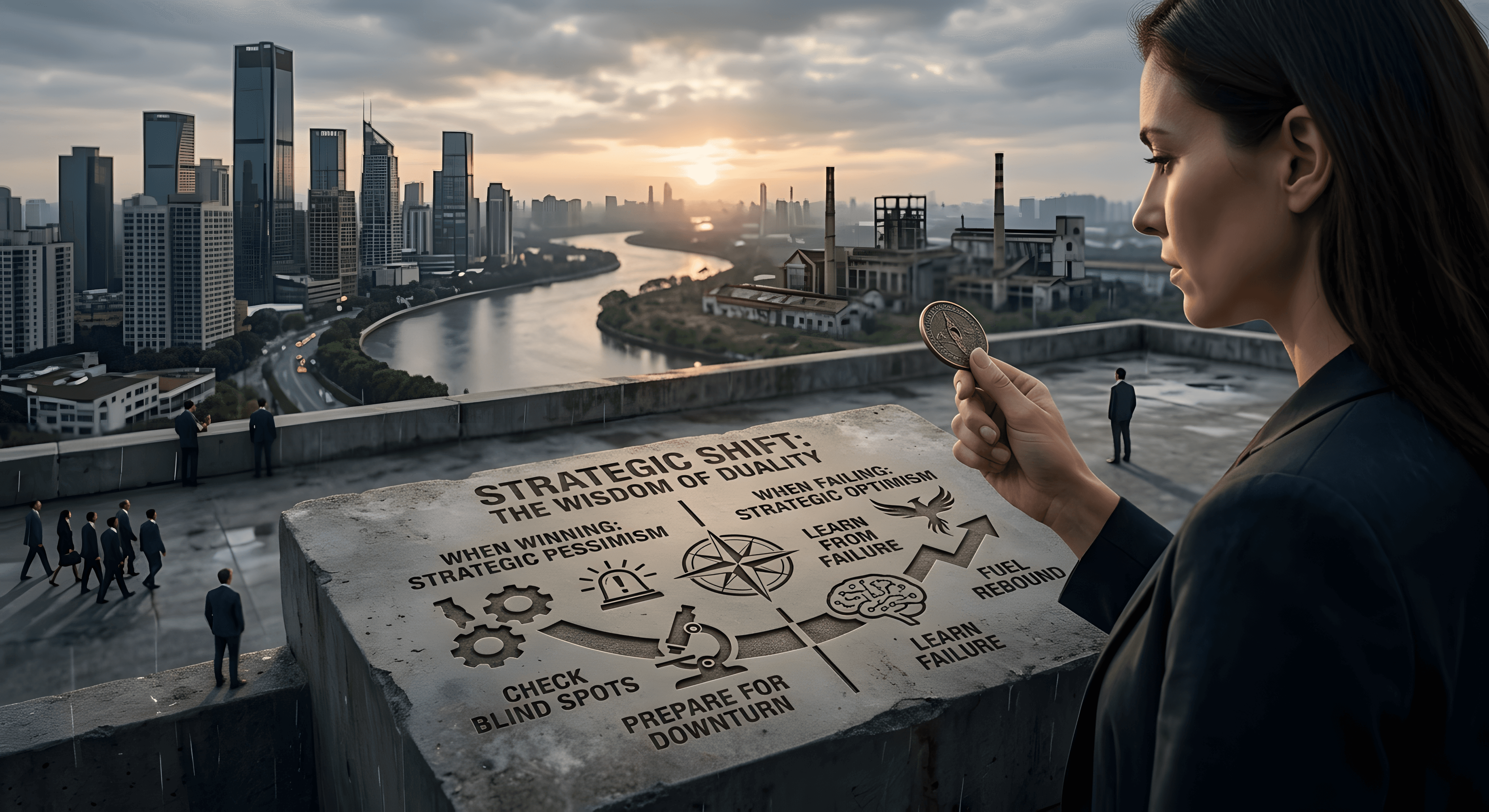
The binary view—that optimism is "good" and pessimism is "bad"—is a fallacy that masks the complexity of real-world survival. A truly rational individual does not commit to one side of the coin; they rotate the coin based on the situation.
When you are winning: Employ Strategic Pessimism. Expect the unexpected, check your blind spots, and assume that your past success is not a guarantee of future stability.
When you are failing: Employ Strategic Optimism. Use it to transcend the urge to give up, focusing on your agency to solve the problem and improve the outcome.
The objective is not to be a "positive" or "pessimistic" person, but to be an accurate one. By decoupling our emotions from our strategies, we can leverage these two powerful human tendencies to navigate the complexities of reality with precision. In a world of blind optimists, the person who knows when to be cynical and when to be hopeful holds the ultimate competitive advantage.