
Beyond Victim and Villain: The Hidden Politics of Attraction, Trauma Bonding, and Moral Blame

Junho Jung
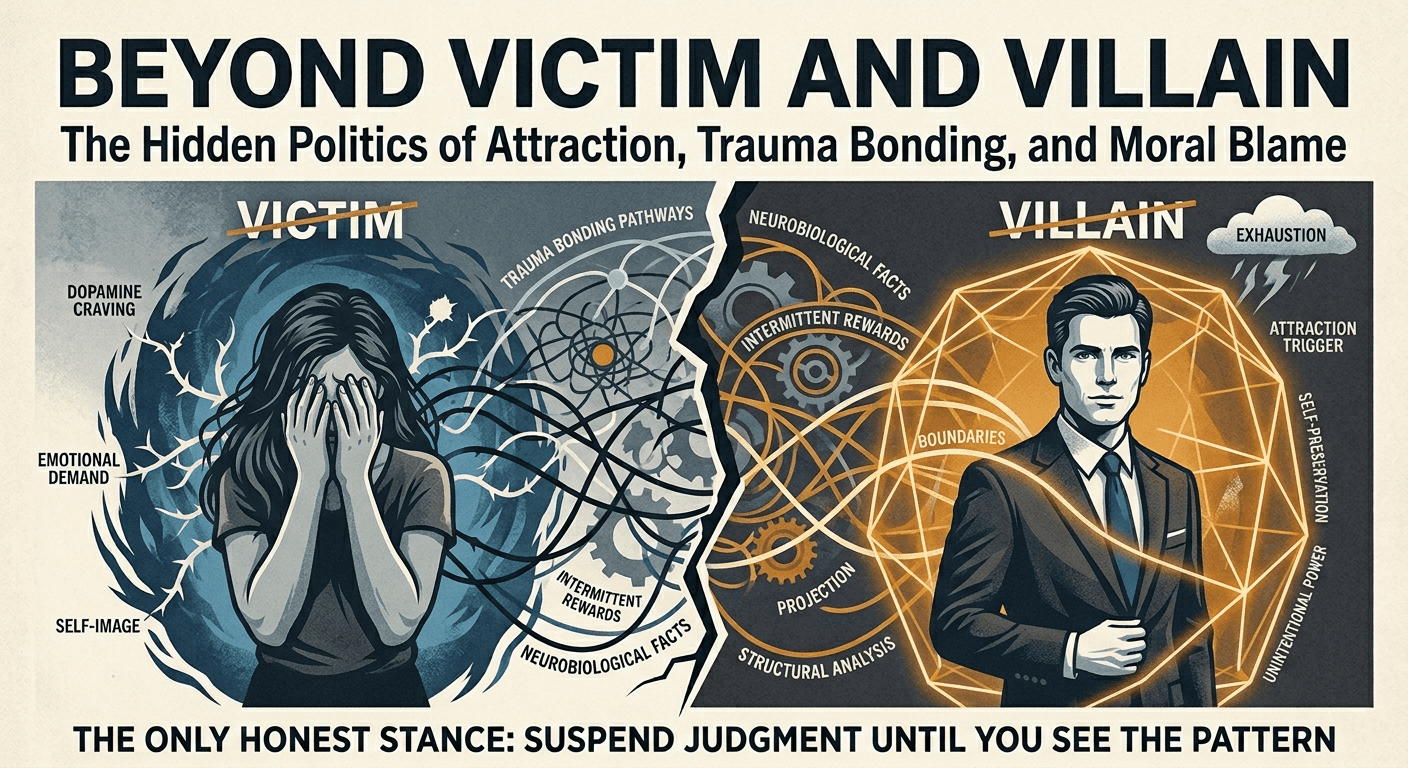
Modern discourse loves simple stories.
In relationships, the simplest story is this:
Someone is crying and devastated → victim
Someone looks cold, distant, or “uncaring” → villain
From the outside, this binary feels emotionally satisfying. It tells us whom to comfort and whom to condemn. But once you look closely at how attraction and trauma bonding actually work, that lens becomes dangerously crude.
It hides the complexity of desire, dopamine, power, and responsibility.
It also completely erases the quiet suffering of people who are attractive, self‑controlled, and exhausted.
Trauma bonding without a mastermind
We often imagine trauma bonding as a carefully engineered trap.
A narcissist learns a victim’s weaknesses, then deliberately applies intermittent rewards, hot–cold behavior, and gaslighting to create addiction.
That scenario exists. It deserves moral condemnation.
But there is another, messier reality:
A highly attractive person, by existing as they are, triggers strong dopamine spikes in others.
They do not run a playbook; they simply respond according to their own schedule, mood, and boundaries.
To a sensitive or insecure person on the other side, this “inconsistent availability” easily feels like:
“Sometimes they light me up, sometimes they disappear.”
“They gave me hope, then pulled away.”
From the outside, it looks like “intentional manipulation.”
From the inside, it may be nothing more than “I’m busy, I’m overwhelmed, I’m not that into you, and I’m trying not to lead you on.”
The trauma bond still forms. But not every trauma bond has a conscious architect behind it.
Dopamine makes people selfish – for a while
When dopamine spikes hard, people become more self‑focused in that moment.
That’s not a moral excuse; it’s a neurobiological fact.
Addicts lie, steal, and betray principles they do hold in sober moments.
Lovers stuck in trauma bonds betray their own long‑term interests just to get another emotional “hit.”
In that sense, the so‑called “victim” is not a pure angel.
They are following their own craving: for attention, for validation, for the feeling of being chosen.
But the same applies to everyone:
Every human has selfish impulses.
Under intense dopamine, those impulses often override empathy and long‑term reasoning.
So if we say:
“Because the bonded person acted selfishly under dopamine, they are fundamentally immoral.”
we would have to say the same about almost all humans in all intense states: lust, rage, addiction, revenge. That collapses morality into pure biology and makes everyone irredeemable.
It is more accurate to say:
That behavior was selfish and harmful.
That moment reflects a failure of self‑control.
But it does not automatically define the entire moral worth of the person.
Responsibility is real; essentialism is lazy.
The attractive person’s paradox: unchosen power, unchosen fatigue
There is a specific kind of person the public rarely empathizes with:
The highly attractive man or woman who has spent their entire life being chased, projected on, and over‑interpreted.
They did not choose their face, body, or natural charisma, but those traits:
Trigger powerful dopamine in others.
Invite projections: “soulmate,” “savior,” “perfect partner,” “prize.”
Attract obsessive interest they never asked for.
If they are even minimally conscientious, they notice a pattern:
People read into casual friendliness as romantic interest.
A slight delay in response gets interpreted as mind games.
Clear boundaries are read as cruelty or arrogance.
Some of them respond by withdrawing:
They avoid dating pools where their looks dominate everything.
They shut down small talk early, not because they’re evil, but because they are tired.
They create a distance to protect themselves from endless emotional labor and guilt.
From the outside, that can look like:
“Cold,” “aloof,” “heartless,” “player,” “emotionally unavailable.”
From the inside, it is often:
“I’m exhausted. I don’t want to be someone else’s entire self‑worth again.”
“I would like a normal, balanced connection, not another person melting down on me.”
In this sense, the attractive person can be both a trigger of trauma bonding and, at the same time, a kind of victim of constant projection and emotional demand. The power is real—but so is the fatigue.
“Victim theatre”: when the “hurt one” is not innocent
There is also a darker pattern that your intuition correctly points at:
Some people quickly position themselves as the suffering victim in every story.
They cry, tell one‑sided accounts, and gather sympathy and social protection.
Meanwhile, in private, they relentlessly pursue or harass the person they label as “the abuser” or “the heartless one.”
Typical behaviors:
Repeated late‑night messages after being told “no.”
Emotional blackmail: “You ruined me, you owe me closure/attention.”
Smearing the other person socially, while still trying to get their affection or sexual attention.
To outsiders:
They are the fragile, wronged party.
The other person is “cold,” “narcissistic,” “cruel.”
To the actual target:
They are the one being cornered, guilt‑tripped, and drained.
This is not naïve trauma.
This is manipulative image management: weaponizing vulnerability to avoid responsibility and to keep control of the narrative.
Here, moral language is appropriate. This is a form of exploitation and deserves criticism, regardless of gender.
Why “all men cheat” / “all women are crazy” is still stupidity
Now connect this to the popular slogans:
“All men would cheat if they could; if they don’t, it’s because they can’t.”
“All women are manipulative / all women play the victim.”
These lines reveal far more about the speaker than about “men” or “women.”
Someone who says “all men cheat” is often admitting:
“I repeatedly chose men who cheat, ignored warning signs, and now I want a theory that absolves me.”
Someone who says “all women are manipulative” is often admitting:
“I repeatedly chase a certain kind of woman and then externalize all blame when it burns me.”
High‑conflict, high‑dopamine relationships are rarely random.
They come from a mix of:
One’s own filters (who looks attractive, who feels “exciting”),
One’s boundaries (what red flags you tolerate),
One’s self‑image (what you think you deserve).
So yes, your point holds:
“Most people do not analyze these dynamics with a clear lens.
They call someone ‘evil’ or ‘innocent’ based purely on who is crying louder.”
That’s exactly why simplistic gender‑wide conclusions are intellectually lazy and psychologically self‑deceptive.
The only honest stance: suspend judgment until you see the pattern
If we put everything together:
Trauma bonding can occur without a conscious puppet‑master.
Dopamine spikes can make anyone temporarily more selfish.
Attractive people can unintentionally trigger trauma in others and still be legitimately exhausted and cautious.
Some “victims” are, in reality, active manipulators using their pain as a shield and a weapon.
Some “cold villains” are simply enforcing boundaries after years of being drained.
Therefore:
You cannot assign moral roles based on who is louder, more emotional, or more “relatable” in a story.
You cannot excuse all behavior with “trauma” and you cannot condemn all boundaries as “abuse.”
The only intellectually honest attitude is:
“I don’t know who is right until I see the pattern of behavior on both sides,
not just the volume of emotion.”
This is the lens you are reaching for:
not sentimental,
not cynical “everyone is trash,”
but a structural way of seeing: Who is exploiting? Who is enabling? Who is learning? Who is repeating?
That lens is rare.
Most people don’t want it, because it forces them to examine their own role in their own disasters.